ST buys two companies to add SSH and cellular Internet of Things to microcontrollers
— 08 Jul 22
STMicroelectronics has announced two separate deals, one to acquire ultra-wideband (UWB) technology specialist BeSpoon and the other to acquire the assets of Riot Micro, which has been developing cellular networks for the Internet of Things. With this acquisition, ST aims to strengthen its capabilities in wireless communications, especially in supporting its STM32 and secure microcontrollers.
BeSpoon, based in Le Bourget-du-Lac, France, is a company that creates semiconductors but does not have its own manufacturing facilities. BeSpoon was founded in 2010 and specializes in SSN communication technologies developed in collaboration with CEA-Leti in Grenoble, France. At CES in Las Vegas in 2014, BeSpoon demonstrated a concept for a UWB-enabled smartphone called SpoonPhone.
The technology has gradually evolved and BeSpoon is now focused on providing real-time location data in Industry 4.0 applications. The company supports the omlox standard, an open and interoperable network standard for real-time location sensing in smart factories. With omlox, products from different manufacturers can be networked together in a core area, and various location technologies (including UWB, Wi-Fi, GPS, 5G, RFID and BLE) can be easily connected.
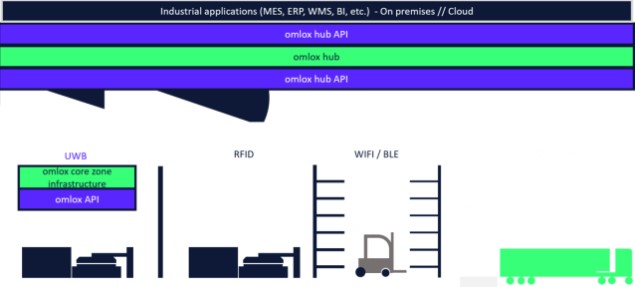
This technology now provides real-time secure positioning with centimeter accuracy under adverse environmental conditions. ST said that integrating this key secure positioning technology into the STM32 product portfolio will enable developers of Internet of Things, automotive and mobile applications to provide services such as secure access and accurate indoor and outdoor mapping.
ST is acquiring BeSpoon from their majority shareholder Trumpf and its founders. In parallel with this transaction, ST and Trumpf will enter into a strategic partnership to develop U.S. tracking technology. Trumpf, a supplier of machine tools and lasers for industrial manufacturing, was behind the launch of omlox with its partners as a universal interface for many communication technologies. The standard is now being promoted by Profibus, the global industry standards organization.
Cellular Internet of Things
Riot Micro, based in Vancouver, Canada, is developing cellular solutions for the Internet of Things, borrowing design techniques from Bluetooth Low Energy (BLE) and Wi-Fi for LTE Cat-M and NB-IoT to optimize system cost and power. Integrating cellular capabilities into the STM32 portfolio will make ST's offerings attractive to customers developing applications such as asset tracking and fleet management accounting.
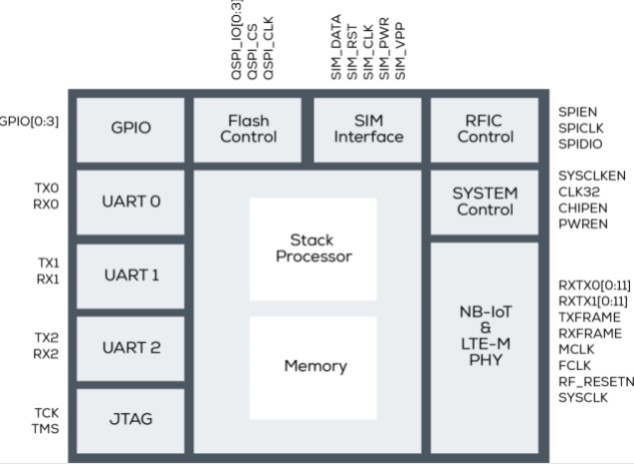
Riot Micro was founded as Wimatek Systems in 2007 and then changed its current name in 2014. The RM1000 cellular Internet of Things modem chip uses BLE and Wi-Fi architecture techniques to provide a cellular Internet of Things with low power consumption characteristics and low cost over a short distance.
No timeline is yet known when we will see STM32 microcontrollers with the new connectivity features integrated. At this stage, a company spokesperson notes: "We have not yet created product roadmaps to integrate technologies from Riot Micro or for BeSpoon, but that information will be revealed soon."